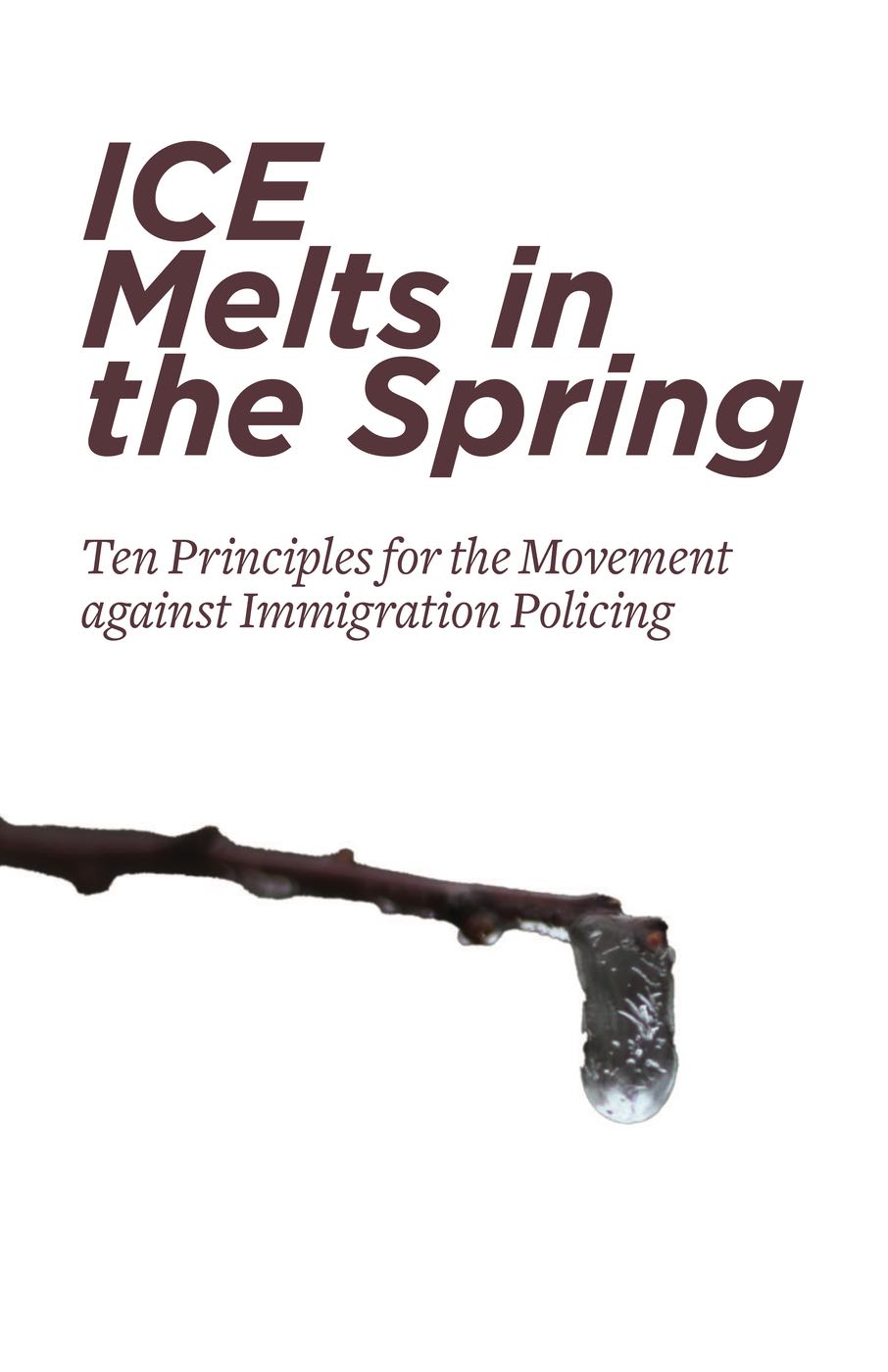
Photo of ‘ICE Melts in the Spring’ front cover
- Size 5.5" x 8.5"
- Pages 6
What shared principles could serve as the foundation for a powerful movement against the persecution of immigrants? We suggest ten baselines for collective struggle.
This text emerges out of discussion and organizing among partisans of color and others impacted by the violence of the border, synthesizing lessons from the past twenty years of resistance to Immigration and Customs Enforcement. These perspectives are informed by our experiences as people directly targeted by immigration, policing, and white supremacy and as aspiring revolutionaries involved in movements from Los Angeles and Chicago to the Twin Cities and the southern borderlands. Here, we attempt to articulate common principles for our movement, in hopes of working together effectively to create a future beyond borders, policing, and racial violence.
1. We are in a fight with the federal government. This means taking risks, and the law will not always be on our side. Stopping ICE will require more than legal observing, reform, and other strategies that play within the rules of the existing order. We can only stop ICE through mass resistance that interrupts, prevents, and deters deportation operations. We should evaluate tactics and strategies according to how much they enable people to engage in this kind of resistance. For example, the mass distribution of whistles and other tools that equip people to intervene against ICE and police operations is a step towards the kind of resistance we need.
2. We do not police the actions of other protesters. No one way works. It will take all of us shoving at the thing from all sides to bring it down. The mass resistance we need cannot be directed by any one group or limited to any one strategy. It will require many different approaches and experiments, filling different roles in the struggle towards abolishing ICE. We should seek to make our efforts complementary and collaborative rather than trying to control or denounce each other.
3. No one person or organization can speak for all immigrants or organizers. Anyone claiming to should be viewed with suspicion. No community is a monolith. Immigrant organizers themselves differ on what strategies are best, what the movement’s ultimate goals should be, and what tactics they support. We should not unthinkingly defer to any one organizer or group, but develop our own analyses, articulate our own proposals, and respectfully talk through our disagreements.
4. We keep us safe by fighting together. Though some will tell us to defer to the most cautious and “respectable” elements in this movement, we should follow the lead of those who demonstrate the most effective tactics. Immigrants have long been at the forefront of resisting the deportation machine: besieging ICE facilities, blockading highways and airports, organizing resistance from inside detention centers, taking the streets, and chasing ICE out of neighborhoods. Many immigrants believe that the greatest chance of safety and collective power is to be found in direct resistance.
5. There are no good pol/ICE; there are no bad immigrants and no bad protesters. All immigrants deserve the same access to a life with dignity and community that citizens do. All protesters who face attacks from the government and stand strong without turning on the movement deserve our support. The regime wants to divide us according to false dichotomies—respectable/criminal, documented/undocumented, upper class/lower class, guilty/innocent, civil/uncivil, violent/non-violent. This is a strategy to turn us against each other so they can defeat us. We want to de-escalate all conflict that isn’t with the enemy. We stand in solidarity with all who are disrupting ICE and resisting the criminalization of immigrants.
6. Turn to each other, not politicians. This violence did not begin with Trump. Entrenched politicians of all stripes have perpetuated it for decades. Across the country, local politicians claim to oppose ICE while sending police to suppress the resistance or making backroom deals with the regime. Politicians will not save us. At best, they are powerless; at worst, they are complicit. We must build the collective power and resources we will need to defend our communities ourselves.
7. Stop waiting for permission. We all have a responsibility to take the initiative in the fight against ICE. Our oppressors win by convincing us that we lack the power to act immediately for liberation—that we must wait for permission or guidance from authorities, leaders, or specialists. A culture of resistance emerges from the recognition that all of us have the ability to imagine different realities, the power to act to bring about those realities, and the responsibility to do so. The density of many different autonomous projects is what has made the resistance against ICE effective.
8. Build trust to defeat fear. A genuinely popular movement will require rapidly building new relationships and trust on the basis of shared values or shared experience taking action together. Taking small risks together today can prepare us to take bigger risks together tomorrow. There are many forms of action that do not require high levels of preexisting trust—for example, mass Signal chats enable rapid response work more effectively when they are open to everyone who needs to coordinate. Work with people you know and trust on projects that involve greater risk or sensitive information. Sometimes, moving at the speed of trust means moving at the speed you can chase off an ICE van.
9. Leave no one behind. We should not settle for empty promises or minor reforms intended to placate us. We don’t want to push ICE off our streets only to have local cops do their dirty work for them. We refuse deals that would make us choose between the freedoms of different communities, trading minor gains for some people for increased policing or misery for others. The unity of our resistance in the streets and our neighborhoods has taught us that none of us are free until all of us are free.
10. Be a good neighbor. We must overcome decades of division and exclusion that have turned us against each other, instilling fear of those who look different, speak different languages, practice different traditions, or have less wealth or property. Excluding people endangers them and weakens our communities. Let us build bridges across all lines of division, fostering a culture of neighborly love based on collective care and abundance. We need communities built on respect, understanding, and celebrating our differences—neighborhoods where people can root into relationships to each other without fear of being displaced at the whim of a landlord, corporation, or government.
Our lives and liberation depend on it.
Further Reading and Viewing
You can find more coverage of the fight against ICE here.
Immigrants Resisting
- Los Infiltradores: How three undocumented activists risked everything to expose the injustices of immigrant detention
- May Day 2006: “A Day without an Immigrant”
Movements against ICE
- They Escalate, We Escalate: A Short History of the Fight against ICE in the Twin Cities
- Previous Tactics from the Fight against ICE
- Defend Our Neighbors, Defend Ourselves: Community Self-Defense from Los Angeles to Chicago
- Chipocalypse Now: Year One of the Fight against Deportation in Chicago under Trump’s Second Term
- Round Table on #AbolishICE: Blockade, Commune, Defend
Videos by subMedia
- Refugees Welcome: Creating Solidarity Across Borders
- Crossing the Line: Border Resistance in Fortress America
Immigration Policy, Border Militarization, and Migrant Justice
- Movement Demands Autonomy: An O’odham Perspective on Border Controls and Immigration
- No Borders Manifesto (2012)
Zines
- Beware the Funders of Immigrants’ Rights
- Designed to Kill: Border Policy and How to Change It
Books
- No Wall They Can Build: A Guide to Borders & Migration Across North America
- Harsha Walia, Undoing Border Imperialism