To Attack or to Mourn?
:The Response to the Murder of Corey Ruiz in Madison, Wisconsin


Since the George Floyd Rebellion of summer 2020, police have continued to murder people at a steady pace, largely without provoking a significant response. Public attention has shifted to the brutality of Immigration and Customs Enforcement, treating police violence as ordinary and acceptable. Yet when police in Madison, Wisconsin murdered Corey Ruiz, demonstrators established a weeks-long occupation in response—raising the possibility that the movement against police could return with a vengeance alongside the movement to abolish ICE. Here, participants in the response to the murder of Corey Ruiz recount their experiences and discuss what it would take to establish a movement capable of putting an end to police violence.
The Madison Police Department murdered Corey Ruiz on the afternoon of Wednesday, July 22, 2026. They killed him in broad daylight on Williamson (Willy) Street. A crowd gathered in horror, recording the gruesome state-sanctioned execution. While this is certainly not the only murder that Madison cops have committed, the attention it received catalyzed a surprisingly large and long-running response for the town of Madison, Wisconsin—a city known for its supposed progressivism and the university’s history of student activism. In the course of these events, it has become abundantly clear that the narratives about social change and “radicalism” that fuel the egos of activists in Madison ultimately offer no way forward in the fight against police violence. We need a movement that is capable of improvisation and attack, not just a politics of grievance with a flashy show of numbers.
Here, we aim to review the larger context of the murder of Corey Ruiz, exploring the political tensions in Madison, the history of the city’s treatment of unhoused Madisonians, and how political organizers and non-profits have failed to get to the root of these issues by making impotent demands. Police violence towards the unhoused community in Madison and towards people of color is rampant in the city; the execution of Corey Ruiz is a continuation and escalation of that violence. Corey’s execution, recorded in cell phone footage, was horrific, and his blood will forever stain the hands of city officials, legislatures, and politicians, as well as the police who carry out their orders.
In 2023, the city government intensified its long war with the houseless by raiding encampments while closing down shelters, defunding them, and moving them outside of the city in order to conceal poverty and struggle from tourists and wealthy residents. Sadly, Corey’s death is only one of many deaths. The names of many that we will never know; our eyes have met, walking to work, on our commute, at bus stations—who knows what has become of them?
Those of us who have witnessed this war unfold in Madison remember the 2020 uprisings, Reindahl Park, and the university occupations for Palestine. What do all of these have in common? They all share the erasure of the houseless and the imposition of a division between the houseless and activists, which short-circuit the logic of an identity politics that becomes incompatible with the moralism of activism.
Corey Ruiz was Black, he was houseless, and he was one of many.
Our opposition to police murder is not dependent upon the moral character of the slain or the identity categories they fall into; it is based in our opposition to police violence itself. If a crowd of 500 people cannot mobilize against the police in a meaningful way, then what the fuck are we doing? We must attack, not just for Corey, but for those who have not yet been killed, for ourselves. Focusing solely on the individual victim of each specific act of police violence leads only to moral positioning. Social movements against police killings and anti-Black violence are limited by their tendency to focus on martyrdom. We must develop a systemic analysis of policing as an institution and seek to act effectively against it.
We do not care what Corey’s legal record is. We are concerned with the role of the police, which is to act as an extended arm of state violence. The law is founded on violence—its entire promise of safety rests on a monopoly of violence.
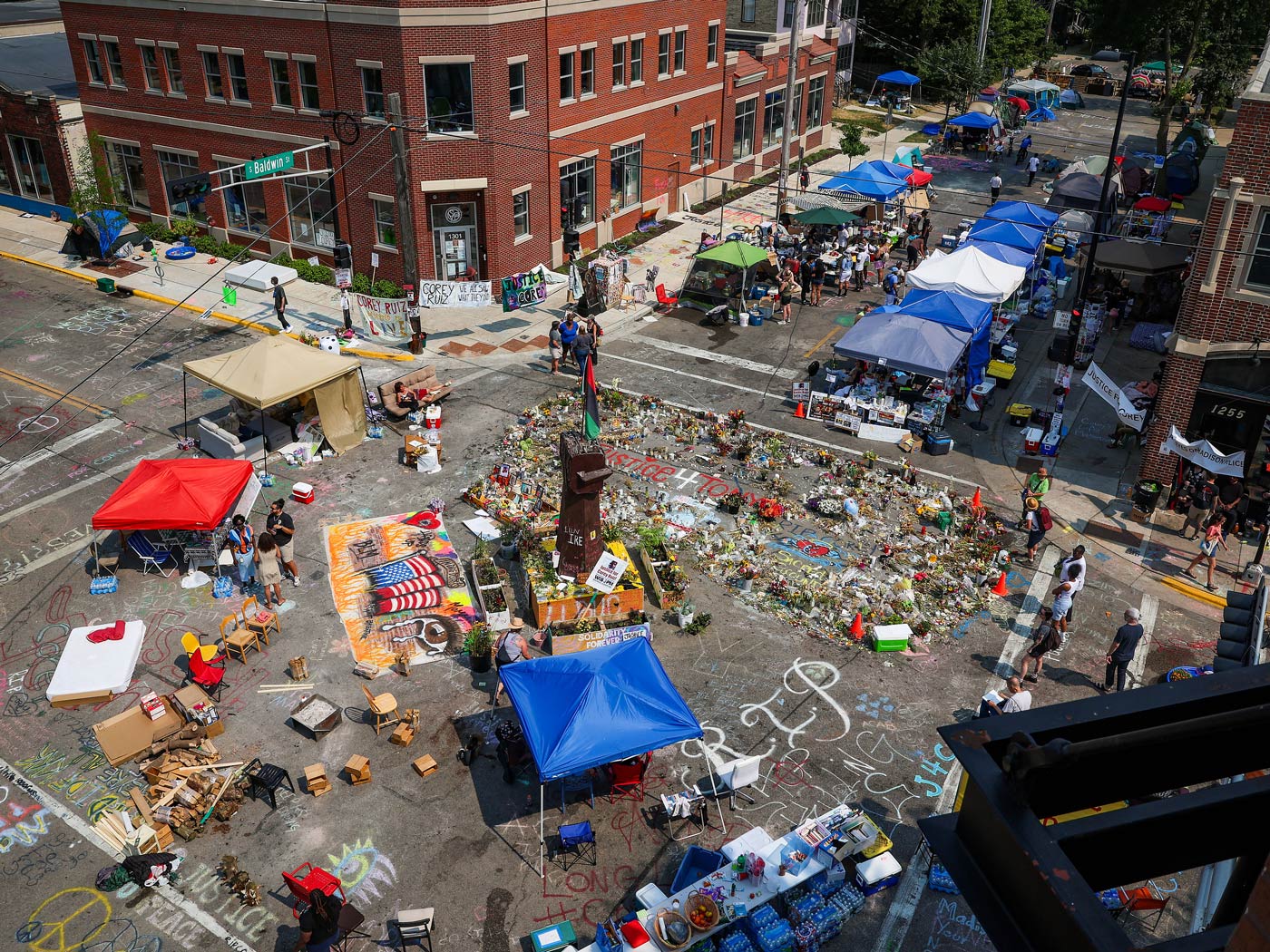
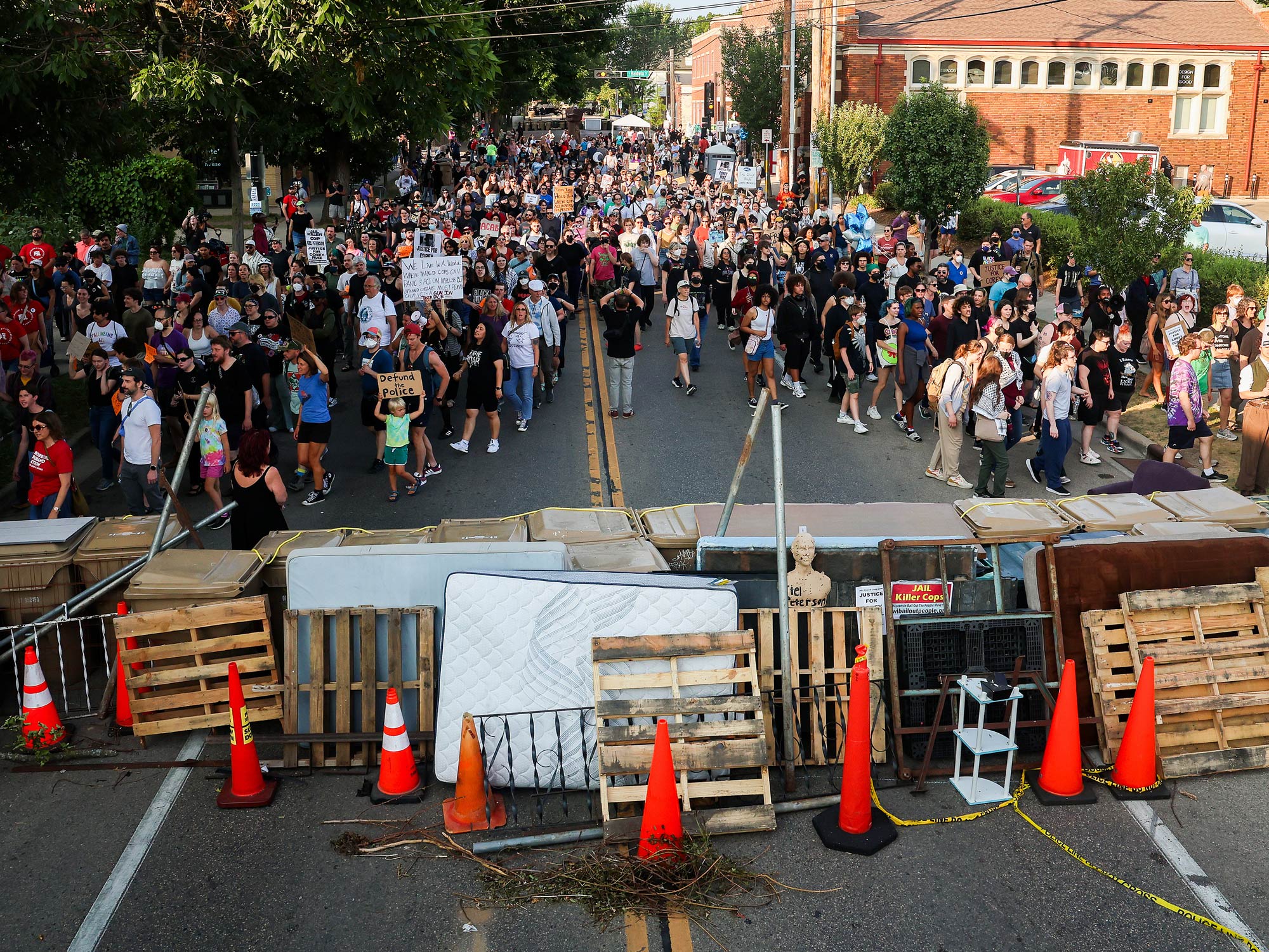
The encampment around the memorial for Corey Ruiz on Williamson St. and S. Baldwin St., seen from the top of 328 S. Baldwin St. on Tuesday, July 28, 2026, featuring the fist statue from George Floyd Square in Minneapolis, Minnesota. Photograph by Owen Ziliak.
Encampment Struggles in Madison 2021-2024
To understand Corey Ruiz’s murder and the context in which the public response to it unfolded, we must look at the forces stripping people of their housing in Madison and the ways that activists and non-profit organizations are entangled with them.
In 2020, when the state failed to protect and provide for its citizens at the height of the COVID-19 pandemic, mutual aid projects proliferated across the country, particularly in the Midwest. The government did not deliver on its promises of protection and resources; eviction moratoriums eventually ran out, and the number of evictions skyrocketed. As various mutual aid projects focused on houseless encampments and resource distribution responded to this situation, this influenced the outcome of subsequent struggles.
When local politicians or non-profits—which are usually silently allied with politicians—try to perform radicalism, we must be prepared to show where they have been and what their true interests are. If they are able to convince their followers that they are “in it with the people,” they will be able to shape the trajectory of social movements to prevent them from pursuing real change. This is not a matter of political purism but a recognition of the political contradictions at play.
Whenever a social movement or occupation begins, pay attention to how people use the words “security” and “safety.” This rhetoric is often used to divide movements and suppress their radical potential. We have repeatedly witnessed how a certain core of activists have co-opted struggles in this city for themselves and their professional gain.
In 2020, the Reindahl Park encampment on the East Side of Madison was huge. It was impossible not to notice it while driving down East Washington, one of the city’s busier roads. Social workers, non-profit representatives, mental health specialists, and mutual aid groups attempted to establish a foothold within it. At the time, many considered the park to be an autonomous community. Yet the encampment was not without problems: Madison police were known to take people who were under the influence or having a mental health crisis to the encampment and drop them off there, where they would provoke conflict among the residents. It also appeared that undercover cops were selling drugs to people staying at Reindahl.
The city government shut down the Reindahl encampment in winter 2021, using rhetoric about “safety,” “risk” and “violence” to justify doing so, as well as alleging that the inhabitants were selling drugs. Those of us who were present during those struggles saw how the city began to redirect the social workers and non-profit assignments to a new location, Dairy Drive, which was outside of the city and beyond the reach of Madison public transportation at that time.
In November 2021, emergency federal funds were allocated towards an Emergency Shelter on Dairy Drive. Yet due to the limited availability of places in the Dairy Drive shelter, Reindahl inhabitants became divided as to whether to remain at the park or leave. Those who chose to stay were given short-term vouchers by the city to stay in local hotels. One hotel on the East side, which was gutted and renovated after many unreported deaths of houseless people that winter, has since been turned into “lifestyle apartments.”
The city’s Dairy Drive Emergency Shelter was comprised of an enclave of tiny homes—enclosed by a fence and heavily surveilled by cameras—that housed about 35 people (17 official residents) with pandemic-era emergency funds. The local non-profit Madison Street Medicine operated it. Unsurprisingly to anyone who has attempted to organize in Madison, the non-profits fell for the city government’s plan to push poor people out of the city, interpreting the Dairy Drive shelter as a dignified way of maintaining the community of the evicted Reindahl Park. The Dairy Drive Emergency Shelter remained open until October 2025, when it was shut down after Madison city alders decided by one vote not to renew its funding.
At that time, many of us already knew that the only way to maintain community was to fight together in solidarity. There were many conflicts around the transition from Reindahl Park to Dairy Drive; unfortunately, little documentation of that social struggle exists for future comrades to learn from.
Before Dairy Drive was evicted, in summer 2024, Madison police violently evicted the Palestine solidarity occupation at the University of Wisconsin-Madison. The attack on the encampment for Palestine illustrates how consistently houseless struggles and broader social justice struggles intersect in Madison social movements. Many who were present at the Palestine encampment witnessed how the student organizers struggled to handle the realities of the houseless population that showed up to support the encampment. The police were regularly called because of altercations and the University of Wisconsin-Madison police flooded student emails for weeks during and after the occupation with alerts about “dangerous activity” in the area. Without exploring the complexities of that particular social movement, we can summarize that the police and the city have consistently weaponized the language of safety and security whenever any semblance of autonomous organizing emerges in Madison.
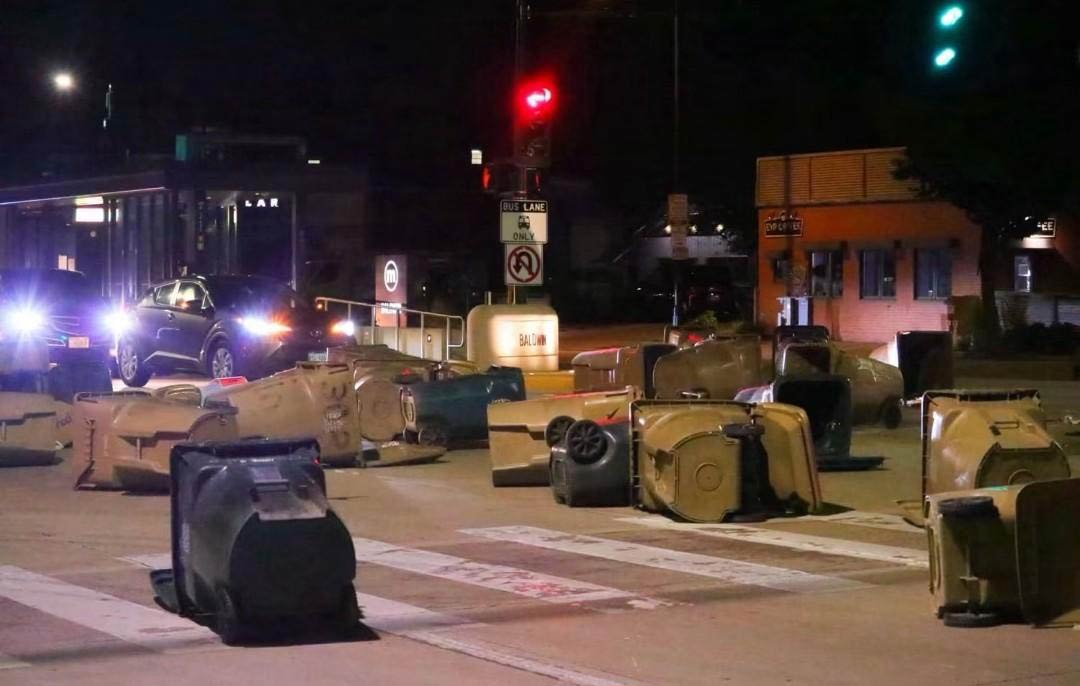
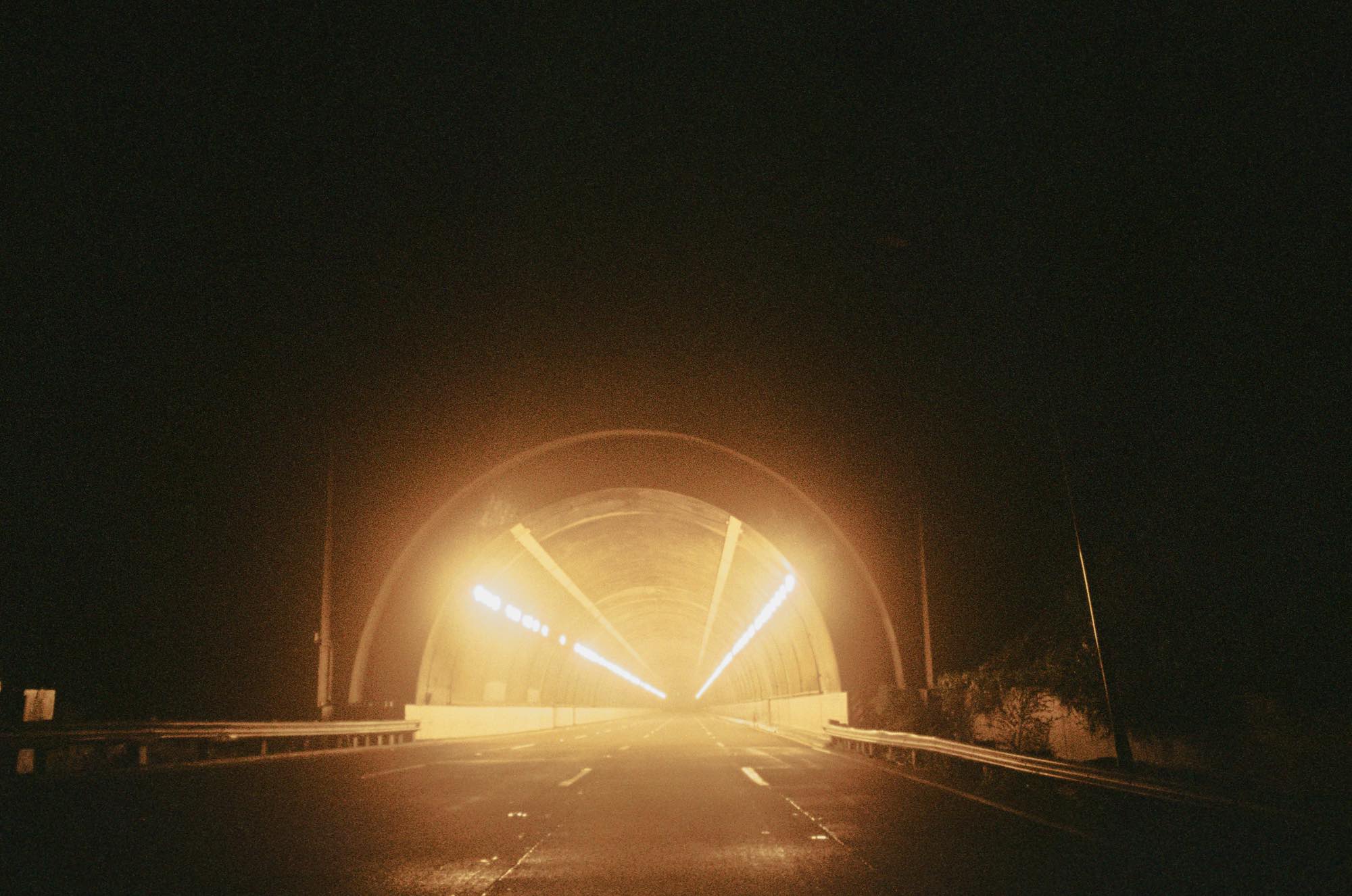
The night of August 4: protesters fought back, lighting fires and scattering trash and recycling bins to block the police.
The Execution of Corey Ruiz, the Community Response, and the Police Attack
Madison Police Officer Kiel Peterson executed Corey Ruiz on July 22, 2026 at the intersection of Willy and Baldwin Streets in Marquette Neighborhood—a gentrified, predominantly white area just east of downtown and the capitol district. Immediately after police left the site of the murder, people assembled there in grief, mourning, and anger, occupying the intersection. What began as a small memorial vigil with candles, flowers, and art quickly grew into an encampment; people brought in tents and started grilling food and building trash-can barricades.
That evening, a large group of protesters marched to the capitol, disrupting the planned Concerts on the Square. Photographs of this protest were shared widely on multiple national news outlets.
The encampment and vigil continued to grow over the following days. People hung several banners up, set up tents to sleep in, and expanded the barricades on all four sides of the intersection. The site of the murder itself was covered in flowers, candles, pictures, and paint, growing larger every day. Several more tame, controlled marches occurred over the following few days, and a fist statue from George Floyd Square in Minneapolis arrived at the site. Madison non-profits, community leaders, and representatives from political organizations including PSL, DSA, and Freedom Inc. increased their presence and pushed their platforms in an attempt to gain numbers for their groups, taking ownership of the marches. A city employee brought port-a-potties to the occupation—voluntarily, not contracted by the city government—and the city government lent numerous salt trucks to reinforce the barricades in the name of protester safety.
Throughout the growth and expansion of the encampment, the city seemed oddly complaisant. Police presence was minimal, although people spotted police drones doing flyovers almost daily.
On Saturday, July 25, over 1000 people marched across the city. The organizers ultimately led them downtown to yell at bargoers around midnight to remind them that “No one parties till Corey’s killer is arrested.” Unsurprisingly, they began to lose numbers, and turnout for subsequent marches dwindled.
In the absence of police and seeming indifference from the city government, the occupation maintained its presence but not its momentum. Though the encampment served as a relatively safe space for unhoused folks to set up their tents alongside activists, activists met this with palpable tension. As had occurred during the Palestine solidarity encampments and other local mobilizations, these activists were uncomfortable when forced to interact with the unhoused community. As the days passed, the vigil site became a site for feel-good white liberal and Black community leader activism rather than grassroots community organizing. People held yoga classes, concerts, and offered support for grieving community members.
Beginning on Friday, July 31, Madison Mayor Satya Rhodes-Conway, a centrist liberal, started asking people to end the encampment voluntarily. This was unsuccessful. Mayor Rhodes-Conway continued to issue increasingly threatening demands for the encampment to disperse; these appeared on August 1, 2, and 3 to no avail.
On Tuesday, August 4, almost two weeks after the murder, city vehicles began circling the encampment at about 3 am. The city government did not officially announce the raid, though activists echoing the mayor’s sentiments had implied that a raid was likely. The presence of city vehicles increased until 5 am, when the sweep began.
Bobcats fashioned with bulldozer blades tried to circumvent the barricades by advancing on the sidewalks. Protesters who feared that they would run over people sleeping in the tents managed to stop some of them. Hundreds of police set up blocks away to prepare for the raid, while city street workers with CAT bulldozers cleared everything in their path.
Some people left, but a group stayed on site as more police arrived. They gathered around the fist statue, locking arms. Having fully prepared the raid, the police attacked violently and in huge numbers, tearing down and destroying the rest of the encampment and arresting several protesters. After the police cleared the encampment, officers maintained a massive presence at the intersection and in the areas surrounding it. They staged at nearby locations such as the City of Madison Metro Transit Office three blocks away, at which you could see between 20 and 40 police cars at any time, and maintained surveillance of the intersection with undercover minivans and drones.
For the rest of August 4, a cat and mouse game played out between police and protesters. People stayed at the intersection of Willy and Baldwin the entire day. Protesters re-occupied the site, marching in a circle at the intersection and chanting with megaphones. Around 4 pm, apparently without provocation, police violently arrested at least two of the more vocal demonstrators. At least once officer deployed pepper spray, injuring several people—many of whom were complying with police orders. Police aggressively threw people to the ground as they shoved the crowd back.
After police cleared the occupation of the intersection, traffic continued to flow, though protesters remained present and tensions continued to rise. Protesters started taking over the curb and the street. Police violently detained one protester, shoving them to the ground and restraining them. Outrage and attempted intervention prompted further detentions, some of which led to arrests. At some point, mounted officers arrived. Police again seized the intersection and began writing citations for jaywalking in an effort to discourage any attempts to reoccupy it. Police also significantly escalated their responses to any homeless or drunk person, with ten or more officers swarming the individual and immediately arresting them.
That afternoon, Madison Police Officer Alex Gonzalez, who killed Madison resident Richard Johnson while on duty in 2024, arrived on site. Protesters demanded Gonzalez’s immediate removal and another officer escorted Gonzalez away. As protesters followed Gonzelez towards the police car, Gonzalez threatened them with pepper spray. People then reoccupied the intersection and gathered around the car with Gonzalez in it. Police threw several protesters to the ground and cuffed and arrested them. One officer nearly fell off his horse in the skirmish. Officers refused to let bystanders collect the names of the arrested and forced protesters back.
That evening, people gathered and marched, eventually reoccupying the intersection. Several trash can fires and at least one dumpster fire appeared in the street. Police arrested several more people.
Throughout Wednesday, August 5, and especially on the evenings of August 5 through August 9, a continuous presence of between ten and forty protesters remained at the Willy and Baldwin intersection, expressing ongoing antagonism towards the police, who made additional arrests whenever people got into the street.
On the evening of Saturday, August 8, local clergy and Black community leaders collaborated with the local organization The Pressure Movement to hold a vigil on the theme of “standing together for justice and human dignity” at the Capitol building. Community leaders made speech after speech urging the crowd to pay attention, hold police accountable—with no suggestion as to how to actually do this—and vote in the primaries “like your life depends on it.” The low attendance at this event felt like the symbolic nail in the coffin for the movement.
Over the days and nights leading up to Corey Ruiz’s funeral on Friday, August 14, and for a few days after, small groups of protesters gathered sporadically at the Willy and Baldwin intersection. But the dwindling numbers of idling protesters assuaged the concerns of cops, who eventually ceased policing the area.
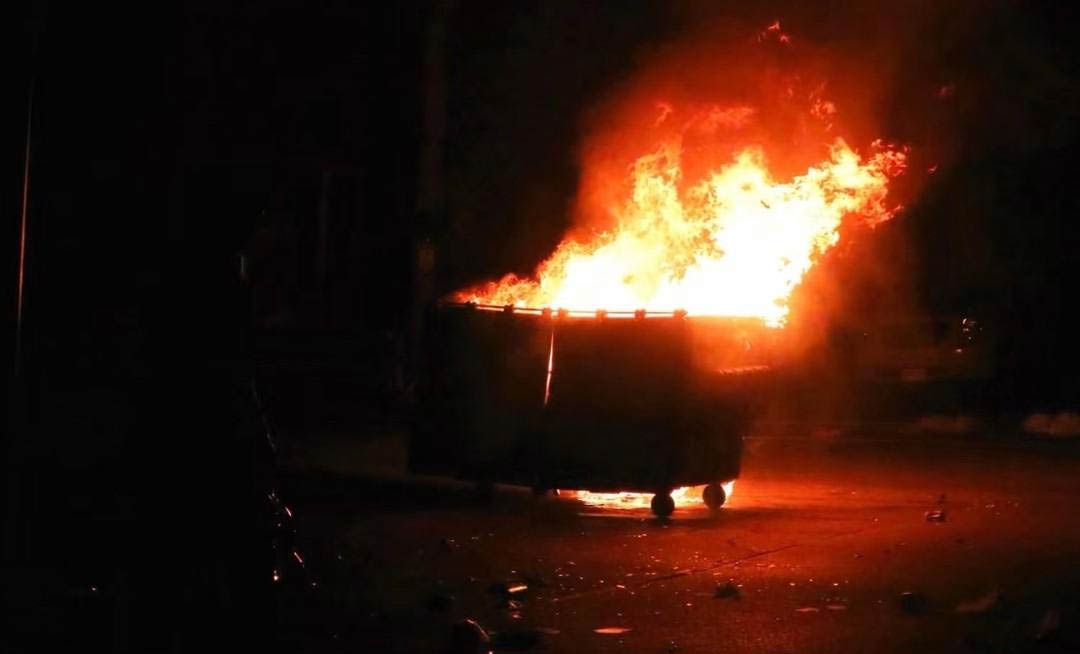
The night of August 4.
Conclusion: To Attack and to Mourn
We must understand the murder of Corey Ruiz by the Madison police in the context of the long-running local struggle of the houseless. We are aware of the proximity between the murder of Tony Robinson in 2015 and Corey’s murder, and we understand the significance of the fact that Corey was a Black man. But activists and organizers failed to draw attention to the fact that Corey Ruiz was unhoused, which could have changed the nature and outcome of the occupation on Willy Street. This parallels the way that the “progressive” city of Madison, Wisconsin has failed to acknowledge its role in the rising houselessness in the city, where more high-rise apartments go up every day.
We saw that a lot of young comrades, radicals, and anarchists who tried to engage in the struggles in Madison were ultimately used as foot soldiers to advance the agenda of a small number of activists and organizers. Grievance-based politics with empty demands almost immediately drained the insurrectionary potential of the occupation. The problem was not mutual aid. It wasn’t white liberals. It was the movement policing that started immediately and the egos of the organizers themselves.
To the young ones we saw there, we want to say:
Trust your intuition, trust your friends, and, most importantly, trust your rage.
Do not listen to police of any kind, whether it be the police themselves or movement police.
Find others who are fed up with the endless marches around the capital, the megaphone wielding, the lifeless chants.
Act. Proceed under the assumption that others will, too. Do not hesitate out of fear that they won’t.
Do not trust the non-profits in the city, do not trust the careerist activists who seek to funnel your rage into their political platforms.
Another lesson that we sincerely hope people have learned is not to entrust your plans to the non-profits and careerists in this city, or any liberal city like Madison. They are not our friends; our ideas and tactics should not be extracted into aestheticizing or reinforcing their vanity projects.
Next time the police kill in this city, locate their infrastructure. Block, attack, and show them we are not to be fucked with again.
—Some Madison anarchists
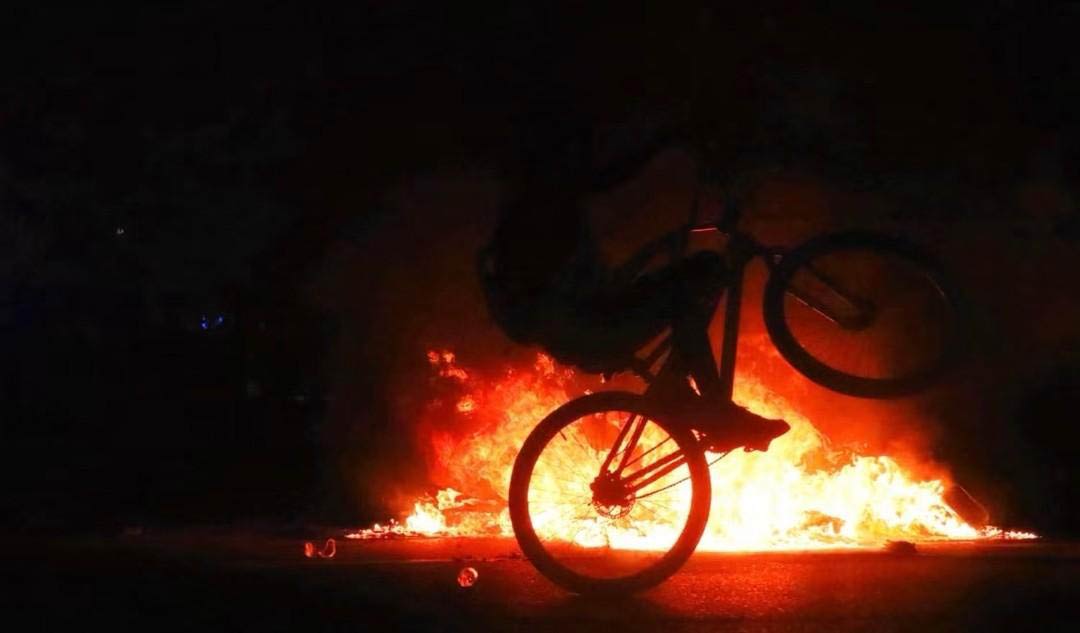
The night of August 4.
Appendix I: Raven’s Testimony
My time at the encampment has shaped new perspectives and sharpened existing thoughts. Witnessing community come together how it did was something I never expected. Being already entrenched in the revolutionary space in Madison, I was shocked to see this pop up. This wasn’t the first time I had to eat my words, however.
Although I praise the space for what it was, I can’t help but criticize it for the same reason. First, it was a space for the houseless and housed alike to get together and mourn a member of the community that was lost to the ever-violent arm of the state. A space where food, water, and shelter were provided and mutual aid (although not glamorous) was prioritized. A space where rage and anger matched the sorrow and anguish that many of us felt, the revolutionary energy was immense, our potential was ready to come to fruition. Then… nothing, all that energy got channeled to endless marches to nowhere, with no goals or demands (or at least no demands backed by the threat of action). Chants were as unserious as they were catchy. The attitude shifted quickly to “How do we fix this incrementally?”
“We need to hurt they pockets!” is what I heard when yelling at someone with a bullhorn.
“Fuck that,” I replied. “We have five of them right here! Scared!”
That was before we marched to the capitol square to interrupt an event that was being held there. Around five police officers were at the mercy of the growing crowd on Corey (what was Baldwin) and East Wilson, tensions were flaring and the potential for tangible action was upon us—only to be relinquished by a person who I can only describe as “a fed without a check.” That theme continued to the eventual end of the Corey street encampment.
Being African American myself, I would often look to other AA activists and organizers for guidance, but what I found was that many AA organizers and activists in Madison were there for the wrong reasons. Many already had connections to the city government or were working for or with them directly, a traitorous act, but some did the city’s dirty work for free, which is even more unforgivable. Not to mention the attitudes that some of the “activists” held towards our unhoused community. The truth is, there will always be opportunities to be made from this, more orgs to be built, clout to be chased, and pockets to be lined. Unfortunately, I was naïve and had hoped that the patterns I recognized from 2020 were just in my head. Black leadership in Madison will always sell out to the highest bidder, or worse, for free.
As the days went by, internal struggles and contradictions that were festering started to explode left and right. Rage that should be used against the state started to direct itself internally—we were eating ourselves alive.
The time we had to mend these issues wasn’t enough, and the city knew it. Because it wasn’t a matter of if, but when they would raid us.
The raid itself was violent, as many could guess. I myself had to block city vehicles from running over tents that were occupied. Many people chose to give it up without a fight, and who could blame them? The numbers weren’t on our side.
As I watched the city workers and police advance, my eyes fixed on the fire started near the co-op. Behind it, the intimidating silhouette of a CAT bulldozer emerged. I instantly thought of the struggle in Palestine in that moment.
As the police surrounded us, we linked arms and were steadfast in our commitment to protect the George Floyd memorial. Hundreds of officers from different departments were there to do what they love to do: brutalize and displace. I had my head pushed into the concrete by five or six officers. Still, that was tame compared to what happened to some people.
Nothing to note about jail, it was boring. After the initial arrests, folks started to rally at the corner of Willy and Corey. After hearing about that, all I and the others I was with could think about was how fast we could get back out there.
Over the hours and days following the raid, there were much of the same sidewalk protests going on. There was one night where there was a “riot” (using that term very loosely). I was only present an hour or so after the initial spark, but it wasn’t much. Certainly not enough to get anything meaningful done.
With all this being said, there is still no place I’d have rather been two weeks ago than at the encampment. It was a very powerful space with very revolutionary people. It’s just a shame that we couldn’t do more in those moments.
The movement will live on, and the fight will continue regardless of the setbacks.
Dare to struggle, dare to win.
ACAB, Fuck ICE, 161.
Appendix II: Brief Thoughts for Madison’s Community Defense Movement
Corey Ruiz was brutally murdered by Madison cops nine days after ICE officers shot Joan Sebastian Guerrero to death in Maine. Local police, ICE, sheriff’s deputies: simply different administrative layers of a single, murderous regime. Police killings are the sharpest expression of the violence at the heart of its operation, the same oppressive force that robs us of healthcare, puts us on the street, fills the bosses’ accounts, and compels us to sell ourselves daily for food and shelter. Blue and red public officials and members of the nearly 18,000 police agencies in the US have all sworn to protect this integrated order of dispossession.
Policing is the enemy’s essential “solution” for the problems the regime itself is largely responsible for creating. Therefore, we are forced to acknowledge that it’s only a matter of time before the cops kill again. Given this state of affairs, what does it take to get killer cops off the street, or to make their peers think twice before pulling the trigger? Beyond that, what would it mean to actually stop police terror?
We think an adequate answer to these questions will include two elements.
First and foremost, the authorities only go out of their way to avoid or effectively address these killings when they face a serious threat of popular retaliation. Experience shows they must be made to know such murders will really damage their rule. George Floyd’s killer, for example, was only arrested after the destruction of Minneapolis’s 3rd precinct. The timing isn’t coincidental. Until then, investigators had avoided taking action, saying they needed more time, despite having had days to review clear footage of an obviously heinous act.
We don’t discount the genuine risks at play when we acknowledge the connection between militant direct action and police accountability. We’re simply pointing out that confrontation is a strategic necessity for anyone who would like to make these murders less likely and obtain a shred of accountability after the fact.
Second, there is a need for community self-defense infrastructure that proactively monitors neighborhoods for all varieties of police presence, a network that lets the cops know they’re being watched and enables folks to mobilize quickly when necessary. The anti-ICE groups that have popped up in recent months are a step in this direction.
Within these groups, priority could be given to community patrols that view all agents of state violence (Immigration and Customs Enforcement, Madison Police Department, Dane County Sheriff’s Office) for what they are: lethal threats to people’s well-being. Participants must understand that the anti-ICE and Justice for Corey movements are complementary aspects of a more general, anti-authoritarian struggle. Only then can individuals be clear-eyed about building the power necessary to keep the regime’s abuses in check.
Beyond patrols, this will likely include socializing with previously unfamiliar neighbors, educating them as to how to avoid unnecessary 911 calls, and developing autonomous methods for effectively addressing anti-social behavior.
This is risky, difficult, unglamorous work, but no one can stop police terror without it. Given the gravity of the undertaking, we’d like to end this reflection by drawing attention to some pitfalls observed recently that undermine the movement. We do so from a place of solidarity and hope it will strengthen ongoing efforts in the long term.
Forgoing debate while dismissing tactical suggestions as the likely work of provocateurs deprives the movement of beneficial conversation. Heated, good faith disagreement about the direction of a movement is necessary for a movement’s growth. Such disagreement should accordingly speak to the movement’s goals and capacities and the ways in which certain proposals (don’t) further them.
A corrollary point relates to snitch- or cop-jacketing. Vigilance is a must for everyone, but suspicion of someone’s being a cop or snitch should never be aired publicly without concrete evidence justifying the claim. Raising such accusations in the absence of compelling evidence not only sows unnecessary discord, it potentially paralyzes the movement. In short, it’s the enemy’s work.
Lastly, we can’t help but be concerned by incessant calls to “follow Black leadership.” To state the obvious, Black people are not a monolith. They hold diverse and often divergent opinions. So who do you “follow?” Madison’s Shelia Stubbs? Alex Gee or Brandi Grayson? Barack Obama? Mumia Abu-Jamal? The fight against racist oppression is its beating heart, but the movement needs critical thinkers, not followers ridden with unhelpful amounts of white guilt.
In solidarity,
—Some local comrades